
Do (under) desk bikes really work? An honest answer based on 100+ hours of testing
Yes, desk bikes work. But you're asking the wrong question. A desk bike is just a bike. The real questions are whether it burns enough calories at a work pace and whether you'll actually use it.
Quick summary
- ~170 kcal/hour at a light work pace: roughly double what sitting still burns, without breaking a sweat.
- You can work while pedalling, and you may work better. Light movement raises cerebral blood flow, the same mechanism behind shower thoughts and walking ideas.
- The hidden killer isn't the bike; it's the lack of feedback. Without tracking, most desk bikes end up as expensive clothes racks within a month.
- Under-desk pedals work less well than full desk bikes; short crank lengths cap your range of motion and intensity.
Walk up to your doctor and ask, "Does cycling work for weight loss and cardiovascular health?" They'll look at you like you've lost it. Of course it does. Cycling is one of the most well-studied forms of human exercise in existence.
A desk bike is a bike. So when somebody asks "do desk bikes really work?" what they're actually asking is one of four more specific questions. Let's answer all four properly.
1. Will you burn enough calories to matter?
Short answer: yes, and the math is more convincing than people expect.
We tested this with Favero Assioma PRO RS power pedals, the same instruments professional cyclists use to measure exact wattage at the crank. After several weeks of normal use at a relaxed work pace, we averaged around 35 watts of mechanical output. Run that through a metabolic efficiency model (~18–25% gross efficiency at typical cadence; Coyle et al., 1992) and you land at roughly 170 kcal/hour of total energy expenditure.
| Activity | kcal/hr (approx.) |
|---|---|
| Sitting in a chair | 70–80 |
| Desk biking (light pace) | 165–170 |
| Walking pad (4–5 km/h) | 180–250 |
| Desk biking (max resistance*) | ~850 |
*Sustainable only by trained cyclists for short bursts.
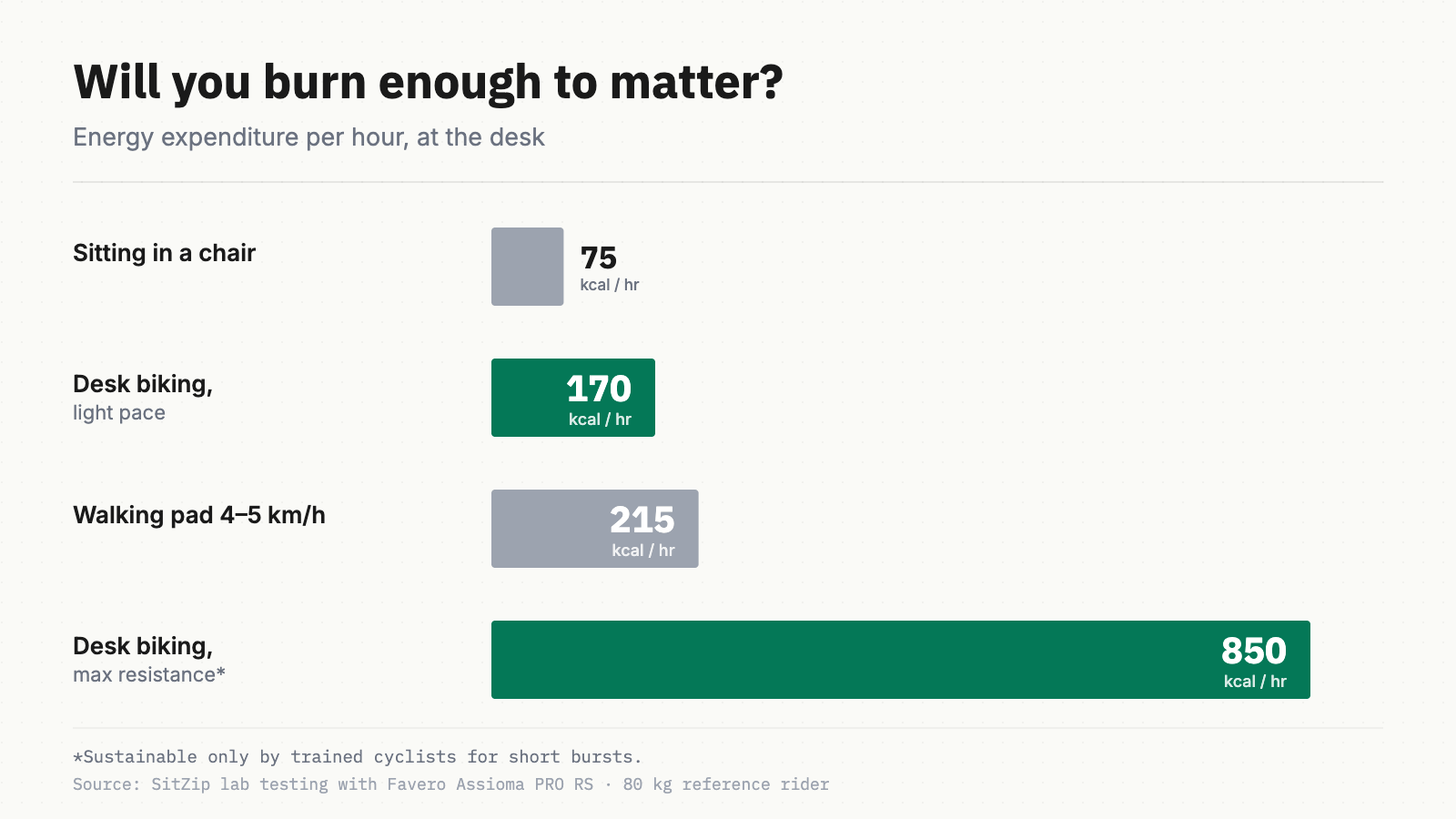
Pedal five out of eight hours at a conversational pace and you've added roughly 850 extra calories burned on top of just sitting. That's a long-run's worth of expenditure, without the run, the sweat, the shower, or the lost time. For a personalised number based on your body weight and intensity, plug yours into the Desk Bike Weight Loss Calculator.
2. Can you actually work while pedalling?
Yes, and counterintuitively your work may get better, not worse.
The mechanical reality
At a normal work pace, a magnetic-resistance desk bike is nearly silent and produces almost no vibration at the keyboard. Your head doesn't bob, your hands stay steady, and video calls don't pick up background motion. We've taken Zoom calls, played chess, written articles, and edited spreadsheets through hours of pedalling without anyone noticing.
A walking pad (the only other "active workstation") loses on this front. The very thing that makes walking valuable (full-body, weight-bearing motion) makes typing imprecise and video calls visibly bouncy at any meaningful pace. Desk bikes win on multitasking by a wide margin.
One caveat: at very high resistance, you'll breathe harder and your focus will drift toward your legs. Fine for short bursts during routine tasks; for deep work, keep the resistance light and the cadence relaxed.
The "shower thought" effect
Your best ideas don't show up at your desk; they show up in the shower, on a walk, in the car, mid-jog. There's a reason for that, and it's the same reason desk bikes can actually improve your work output.
Light physical activity raises cerebral blood flow, delivering more oxygen and glucose to your brain (Querido & Sheel, 2007). At the same time it engages the default-mode network, the loose, associative brain state where unexpected connections happen and stuck problems unstick themselves. Sitting still suppresses this state; movement reopens it. Stanford research measured the effect directly: light walking increased divergent (creative) thinking by roughly 60% compared to sitting still (Oppezzo & Schwartz, 2014).
The same low-effort pace that lets you type cleanly is exactly the pace that boosts blood flow without diverting cognitive resources to your legs. Walking meetings, compressed into the footprint of your desk.
3. The science: why even slow pedalling moves the needle
The LPL effect: burning fat instead of muscle
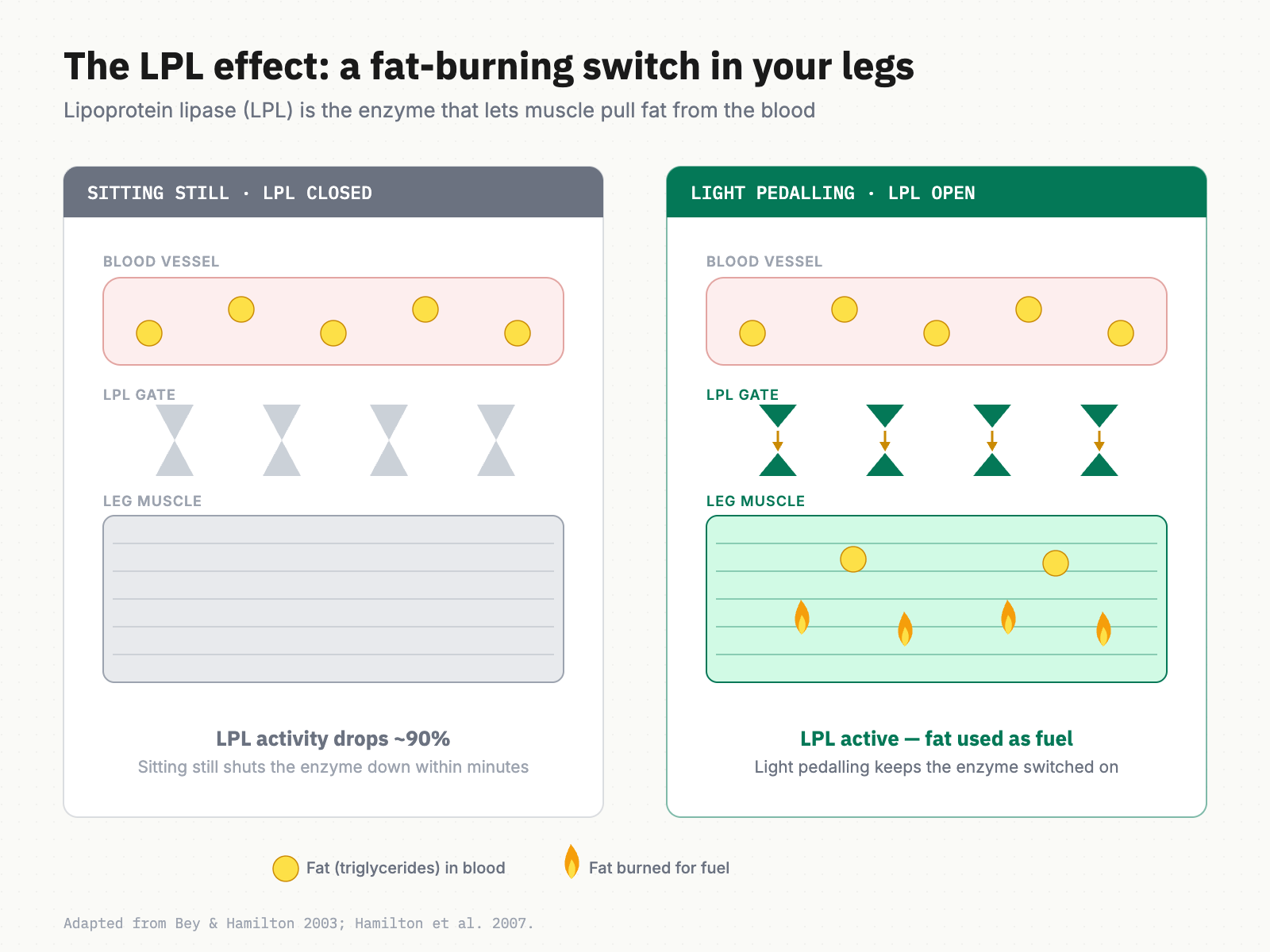
There's an enzyme in your body called Lipoprotein Lipase (LPL): think of it as a fuel injector that pulls fat from your bloodstream and feeds it to your muscles.
When you sit completely still, electrical activity in your leg muscles drops to near zero. Research shows LPL activity can fall by up to 90% (Bey & Hamilton, 2003; Hamilton et al., 2007). Your body essentially stops burning fat; if you're in a calorie deficit, it starts breaking down muscle for fuel instead. This is the mechanism behind the "skinny fat" phenomenon dieters dread.
Light pedalling keeps your leg muscles electrically active. LPL stays open for business. Your body stays biased toward burning fat and preserving lean muscle. You don't need to pedal hard for this; you just need to keep pedalling.
The insulin shield: what happens after lunch
When you eat lunch and then sit perfectly still, your blood sugar spikes. Your pancreas dumps insulin to clear it. Insulin is a storage hormone; when your muscles aren't asking for fuel, it converts the sugar into fat.
Light pedalling after eating changes this completely. Your active leg muscles pull glucose straight out of your blood for energy, so less insulin is needed and your body stays in a using state instead of a storing state. Even short bouts of light post-meal walking measurably improve 24-hour glycemic control (DiPietro et al., 2013), and breaking up sitting with light activity improves postprandial glucose and insulin responses (Buffey et al., 2022). The 2:30 pm energy crash that flattens half the office mostly disappears.
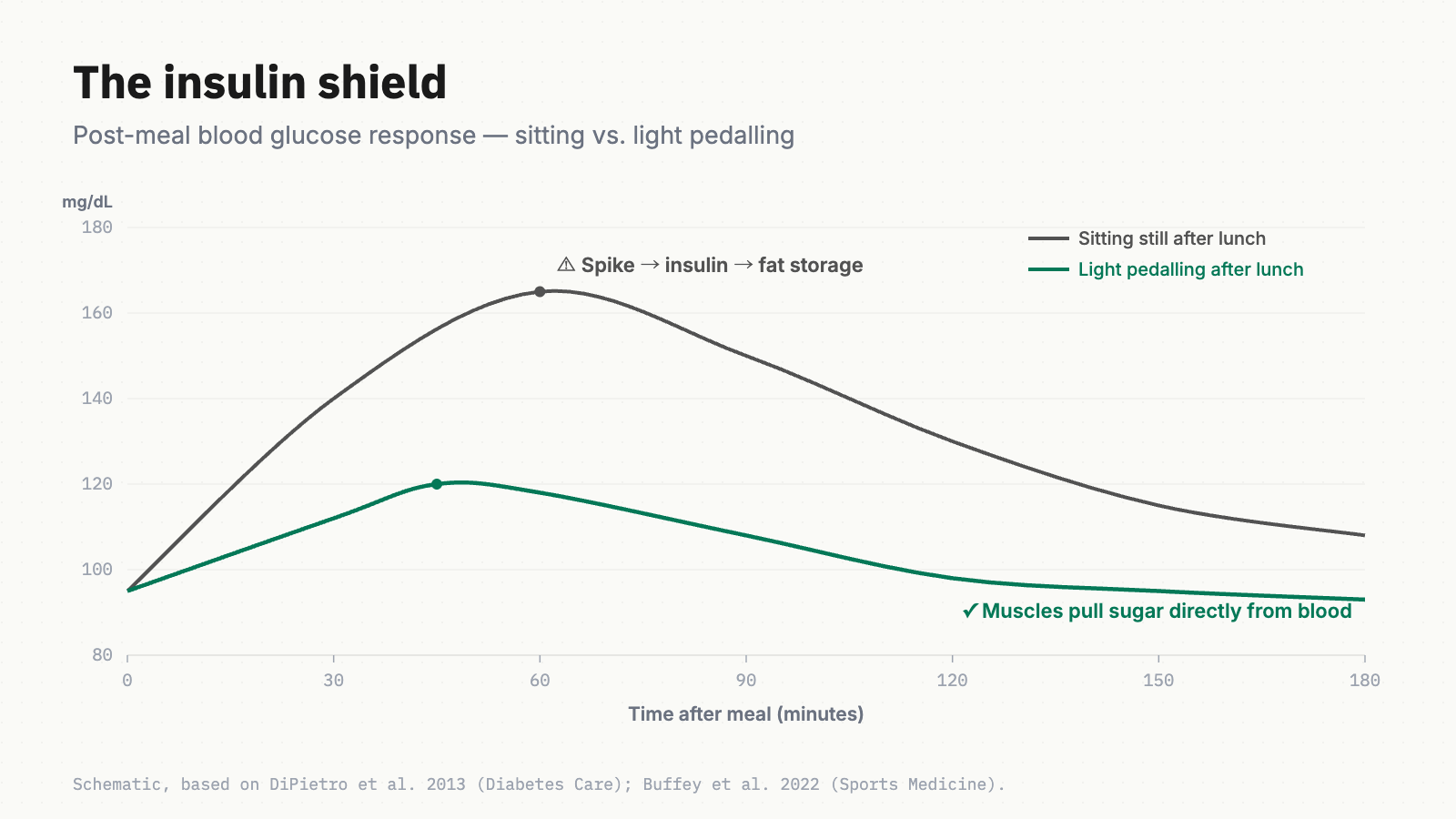
The two mechanisms above are the real reason desk bikes punch above their weight class. It's not just the calories; it's the chemistry.
4. Will you actually use it? (This is where most people fail.)
Roughly 80% of desk bike owners stop using their bike within a month. The bike isn't the problem; the lack of data is.
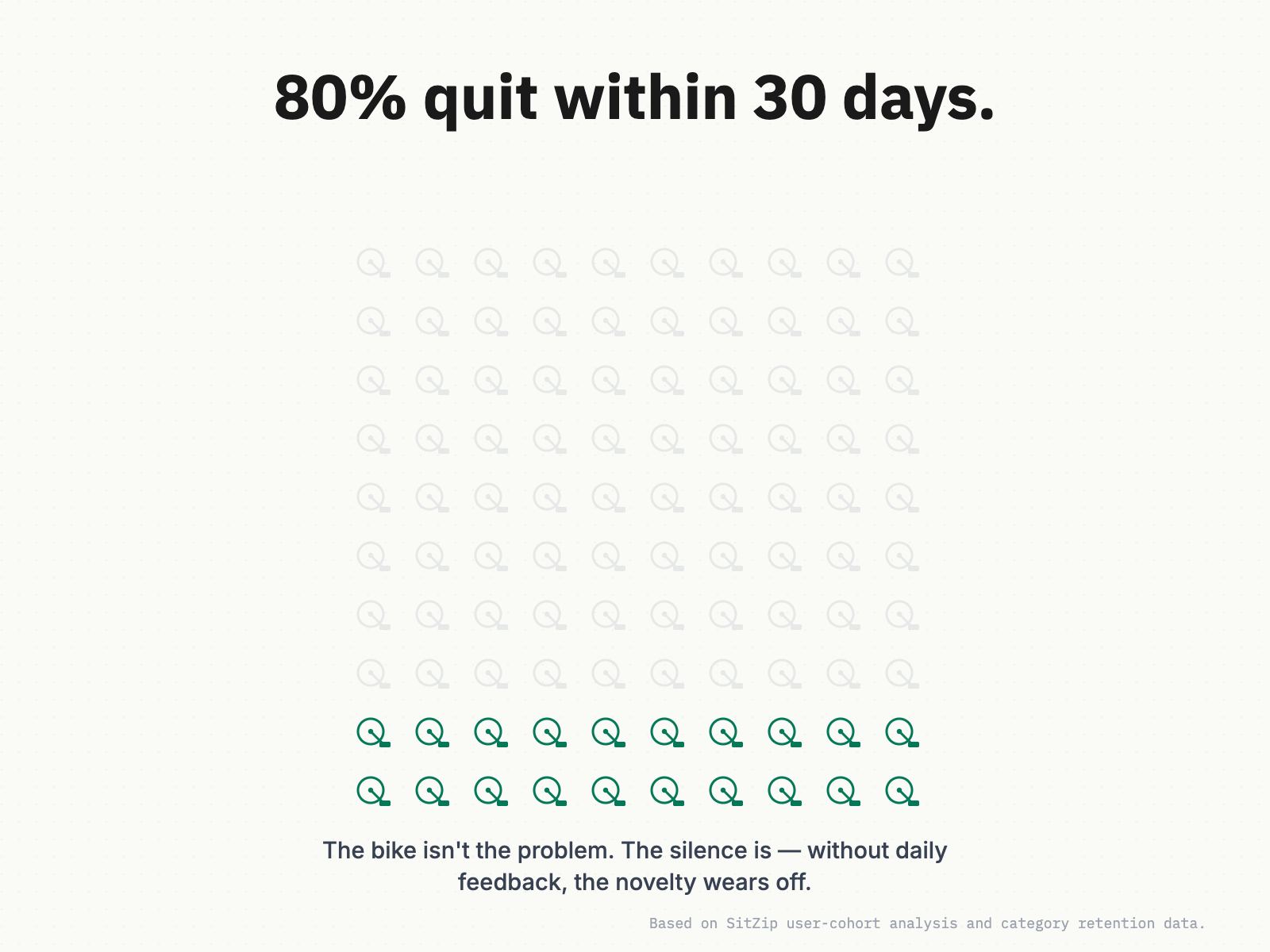
Pedalling without tracking is like driving a car without a dashboard. You don't know how far you've gone, how many calories you've burned, or whether today was better than yesterday. After a few weeks the novelty fades, the feedback isn't there to replace it, and the bike migrates to the corner.
This is solvable. Every bike we recommend is compatible with the SitZip Desk Bike Tracker, which clips onto the pedal arm, syncs to your phone, and turns invisible effort into visible progress.
If you take one thing from this article: whichever bike you choose, install something that tracks your usage before you start. Otherwise you're a statistic in waiting.
5. Are under-desk pedals as effective as a real desk bike?
Short answer: they work, but not as well; for most people, they're the wrong starting point.
The core issue is crank length, the distance from the pedal axle to the crank's centre, which determines the size of your pedalling circle.
- Under-desk pedals use short cranks (often ~100 mm) to fit under a regular desk. Smaller circle, less range of motion, fewer muscle fibres recruited per stroke. You burn fewer calories per minute and you cap out at a much lower intensity.
- Full desk bikes use standard or near-standard cranks (135–170 mm), giving you the natural pedalling motion of a real bicycle. More muscle engagement, more calories, less joint strain.
Under-desk pedals are still the right call for limited space, mobility limitations, rehabilitation, or a strict budget; the DeskCycle 2 is the tried-and-tested model. But if you have the room and the budget for a full desk bike, you'll use it more, burn more, and feel better doing it.
For more on which bike type fits which workspace, see our Desk Bike Buying Guide.
When desk bikes don't work
Desk bikes are not a magic bullet, and there are situations where they're a poor fit:
- Standing-only workflows: if you spend most of your day in front of a whiteboard or moving around a workshop, you don't need a desk bike. A walking pad or just walking meetings is better.
- Severe knee or hip injuries: light pedalling is usually rehab-friendly, but for severe acute injuries you should follow your physician's guidance.
- No standing desk and no flexibility: if you can't raise the desk surface to clear your knees, the ergonomics will be miserable.
For everyone else with a desk job, a desk bike is one of the highest-leverage investments you can make in your long-term health. It removes the decision to exercise. It compounds over hours instead of minutes. And paired with a tracker, it gives you something gyms famously don't: undeniable, daily proof that you're moving the needle.
References
Bey, L., & Hamilton, M. T. (2003). Suppression of skeletal muscle lipoprotein lipase activity during physical inactivity: A molecular reason to maintain daily low-intensity activity. The Journal of Physiology, 551(2), 673–682. https://doi.org/10.1113/jphysiol.2003.045591
Buffey, A. J., Herring, M. P., Langley, C. K., Donnelly, A. E., & Carson, B. P. (2022). The acute effects of interrupting prolonged sitting time in adults with standing and light-intensity walking on biomarkers of cardiometabolic health in adults: A systematic review and meta-analysis. Sports Medicine, 52(8), 1765–1787. https://doi.org/10.1007/s40279-022-01649-4
Coyle, E. F., Sidossis, L. S., Horowitz, J. F., & Beltz, J. D. (1992). Cycling efficiency is related to the percentage of type I muscle fibers. Medicine & Science in Sports & Exercise, 24(7), 782–788.
DiPietro, L., Gribok, A., Stevens, M. S., Hamm, L. F., & Rumpler, W. (2013). Three 15-min bouts of moderate postmeal walking significantly improves 24-h glycemic control in older people at risk for impaired glucose tolerance. Diabetes Care, 36(10), 3262–3268. https://doi.org/10.2337/dc13-0084
Hamilton, M. T., Hamilton, D. G., & Zderic, T. W. (2007). Role of low energy expenditure and sitting in obesity, metabolic syndrome, type 2 diabetes, and cardiovascular disease. Diabetes, 56(11), 2655–2667. https://doi.org/10.2337/db07-0882
Oppezzo, M., & Schwartz, D. L. (2014). Give your ideas some legs: The positive effect of walking on creative thinking. Journal of Experimental Psychology: Learning, Memory, and Cognition, 40(4), 1142–1152. https://doi.org/10.1037/a0036577
Querido, J. S., & Sheel, A. W. (2007). Regulation of cerebral blood flow during exercise. Sports Medicine, 37(9), 765–782. https://doi.org/10.2165/00007256-200737090-00002