
The desk bike weight-loss advantage
Burn roughly 170 kcal per hour at a normal cycling pace. Target stubborn belly fat by regulating blood sugar, preventing afternoon energy crashes, and stopping your body from storing your midday meal as fat.
Quick summary
- Burn roughly 170 kcal/hr at a normal cycling pace, a bit less on a compact under-desk model.
- Target stubborn belly fat by regulating blood sugar and preventing the afternoon energy crash.
- Track calorie burn accurately with the SitZip desk bike app.
- Boost LPL: a fat-burning enzyme that helps your body use fat for fuel and preserve lean muscle mass.
Desk Bike Burn
Powered by physics, Gribble's cycling power model.
214kcal
7.2kg
How we calculate your burn:
We use Steve Gribble's cycling power model to turn your pedalling speed into the watts your legs must produce, adding up gravity, rolling resistance, and aerodynamic drag against an 80 kg rider on a 10 kg bike (Cd 0.63, frontal area 0.509 m², Crr 0.005, ρ 1.225 kg/m³, 2 % drivetrain loss). Then we convert watts to food calories at 18 % gross efficiency — a slightly conservative pick against the directly-measured 16.1 % ± 2.0 reported for healthy adults at 50 W (Wezenbeek & Van Hooren, J Appl Physiol2017), and consistent with the 21.4 % ± 1.1 measured at 120 W in inactive subjects (Fares & Bouillanne, Physiol Rep 2017). Gross efficiency includes the baseline metabolism you'd burn anyway while sitting — the same convention Fitbit, Strava, Garmin and Apple Health use to report “calories burned”. Finally, total annual kcal ÷ 7,700 ≈ kg of body fat.
Three science-backed reasons active sitting beats traditional cardio
Most people think weight loss requires suffering: waking at 5 am for cardio, starving yourself, or spending hours in the gym. For office workers, the secret to a leaner body isn't working harder; it's working smarter.
If you spend 8 hours a day sitting, your body is fighting against you physiologically. By introducing a desk bike or active workstation, you flip the script.
- It prioritises fat burning over muscle loss, thanks to an enzyme called Lipoprotein Lipase (LPL), active sitting helps your body burn fat fuel while maintaining lean muscle mass.
- You can burn 1,000 calories a day by leveraging low-intensity volume, you accumulate a massive amount of energy expenditure without breaking a sweat.
- It stops "lunch storage": active movement regulates your blood sugar, preventing your body from storing your midday meal as body fat.
1. The LPL effect: why you keep muscle and burn fat
One of the biggest risks of dieting is becoming "skinny fat": losing weight on the scale but losing muscle tone with it. This happens because the body cannibalises muscle tissue for energy when you're in a calorie deficit, especially if those muscles aren't being used.
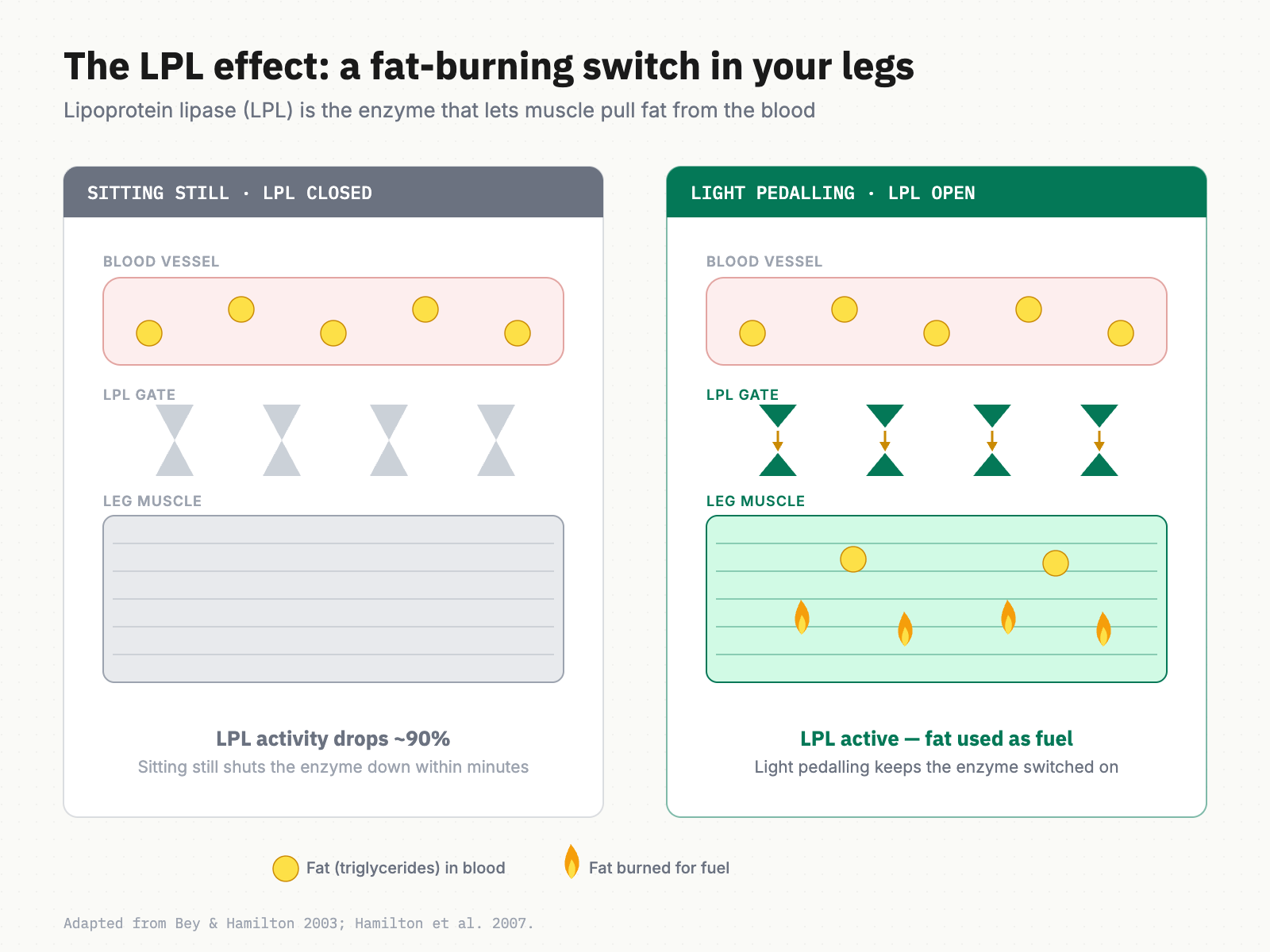
The desk bike solves this through Lipoprotein Lipase (LPL), think of it as a "fuel injector" for your muscles. Its job is to pull fats (triglycerides) out of your bloodstream and feed them to your muscles to be burned as energy.
- When you sit: electrical activity in your legs stops. Research shows LPL activity can drop by up to 90% (Bey & Hamilton, 2003; Hamilton et al., 2007). Your body stops burning fat and starts breaking down unused muscle.
- When you pedal: even light resistance engages the large muscles in your legs, signalling your body to keep LPL levels high.
The result: your body is chemically biased toward burning fat because the LPL "gates" are open, and because you're using your muscles, your body preserves them rather than breaking them down.
2. The math: how to burn 1,000 calories at your desk
Burning 1,000 calories usually requires running about 10 miles, a feat most of us can't do before work. Desk cycling relies on duration, not intensity.
Studies show that while sitting burns roughly 70–80 kcal/hr, light pedalling at a desk burns between 170 and 200 kcal/hr (Carr et al., 2012; Levine, 2007).
Here's what a "1,000-calorie workday" looks like:
- 9:00 am – 11:30 am: pedal while answering emails and doing deep work, burning ~500 kcal.
- 11:30 am – 1:00 pm: lunch break and meetings (sitting/standing).
- 1:00 pm – 3:30 pm: pedal during afternoon tasks, burning ~500 kcal.
Total burn: 1,000 calories. By simply keeping your legs moving at a slow, conversational pace for 5 of your 8-hour shift, you achieve a caloric expenditure that rivals a professional athlete's workout, all without leaving your chair.
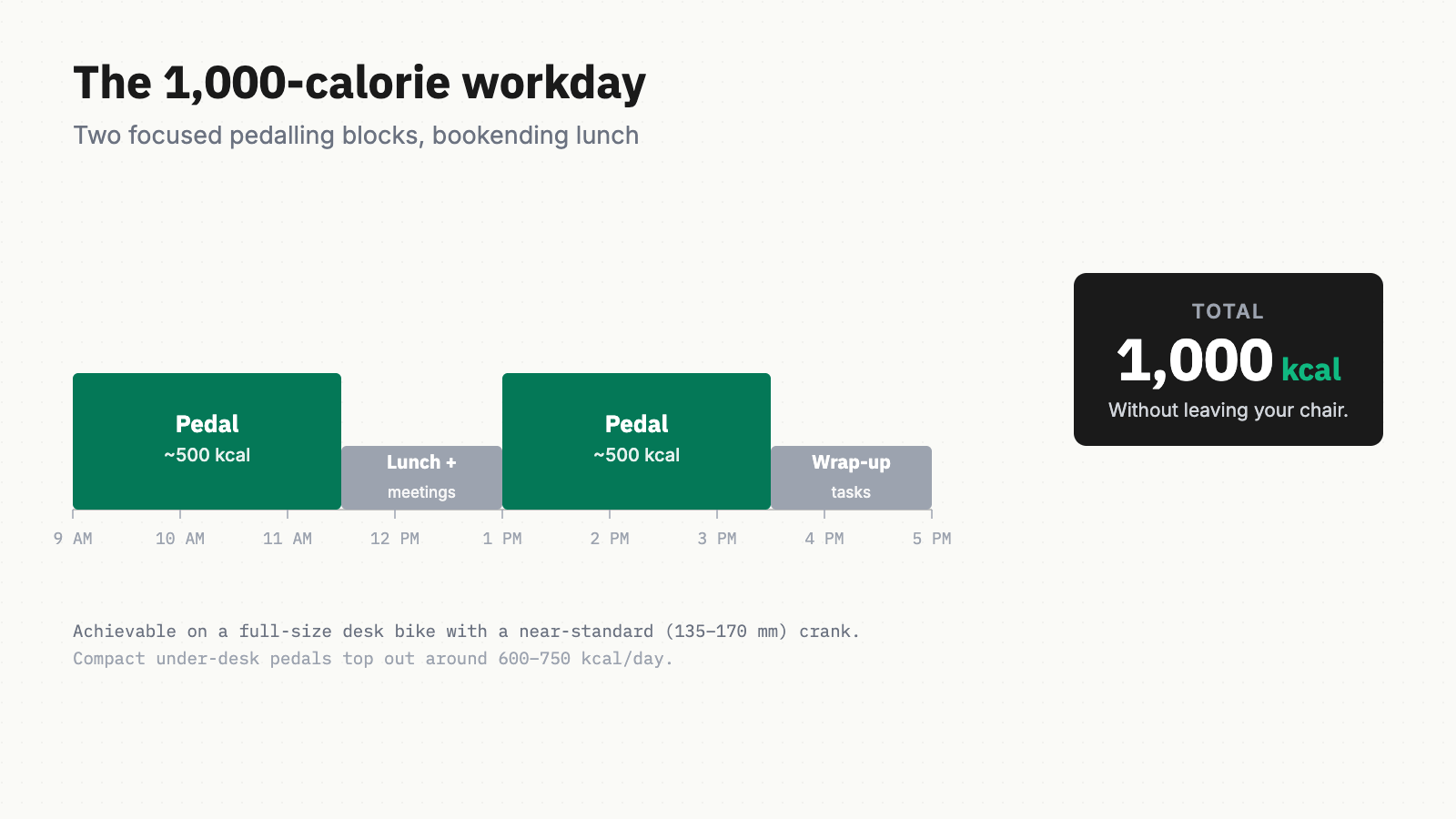
Important caveat: crank length matters. A burn this high is only realistic on a full-size desk bike with a near-standard crank arm (≥ 135 mm). Compact under-desk pedals with short ~100 mm cranks recruit fewer muscle fibres per stroke and cap your sustainable wattage, so the same hours produce closer to 600–750 kcal/day. See why crank length matters in our buying guide.
3. The "insulin shield": protecting your body after lunch
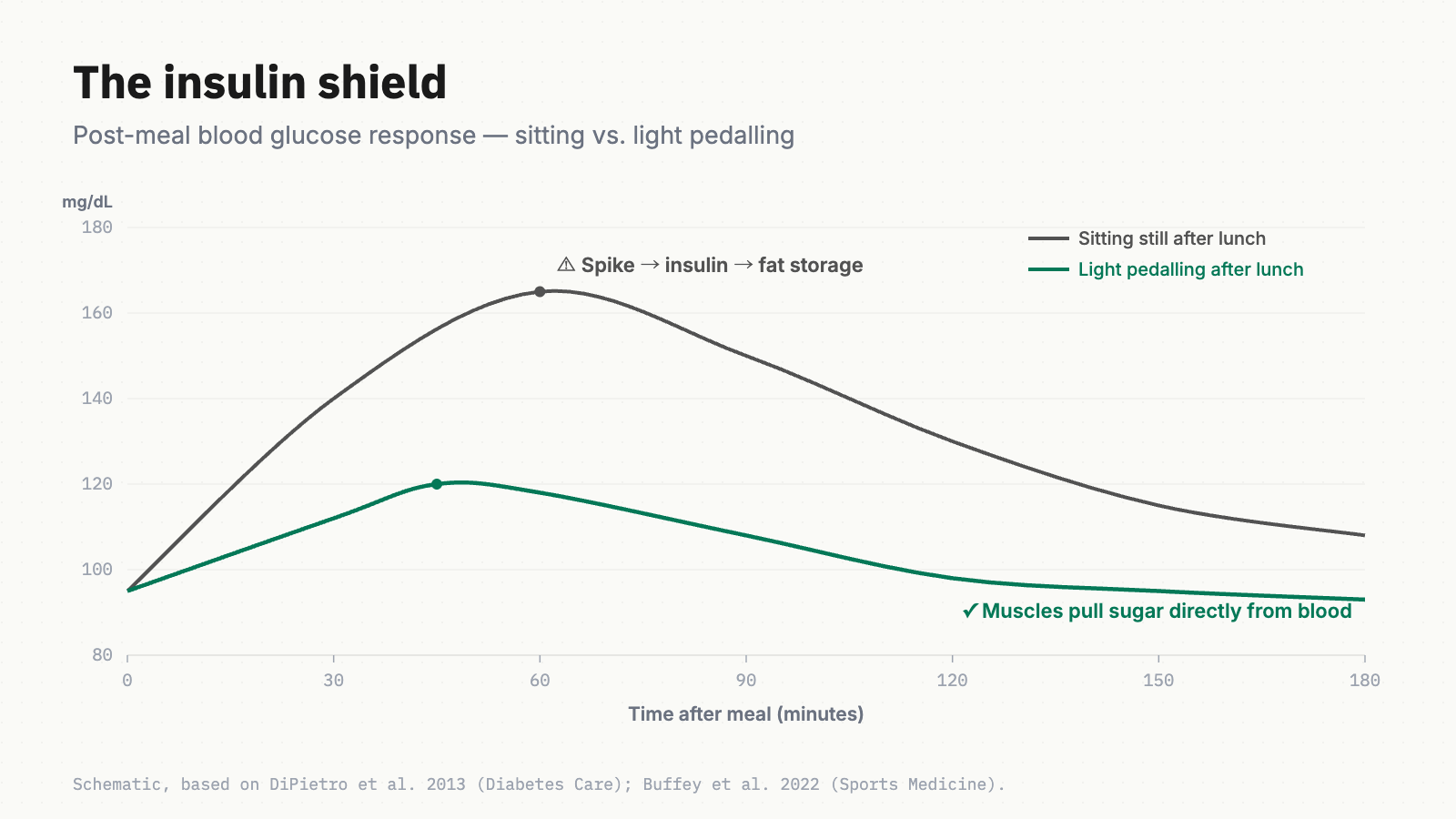
When you sit still after eating lunch, your blood sugar spikes. Your pancreas responds by flooding your system with insulin, a storage hormone whose job is to get that sugar out of your blood and store it. If your muscles are inactive, they won't accept the sugar, so insulin stores it as fat.
Research in Diabetes Care (DiPietro et al., 2013) and a 2022 systematic review in Sports Medicine (Buffey et al., 2022) shows that even short bouts of light activity after meals dramatically blunt the post-prandial glucose spike. The active muscles soak up sugar from the bloodstream directly, leaving little for insulin to convert to fat. You effectively "drink up" the calories from lunch as fuel rather than store them around your midsection.
How SitZip helps you stay consistent
The most common failure mode in desk-bike weight loss isn't physiological; it's behavioural. Roughly 80% of desk-bike owners stop pedalling within a month because they have no feedback signal telling them their effort is producing results. Calorie burn at this intensity is too small to feel, and without a daily number it stops being a habit.
The SitZip tracker pairs with any desk bike to convert pedal strokes into accurate calorie burn, distance, and heart-rate data, turning invisible effort into a visible daily dashboard. If you can see the number go up, you keep pedalling. If you can't, you don't.
Ready to start? Get the SitZip tracker or pick a desk bike.
References
Bey, L., & Hamilton, M. T. (2003). Suppression of skeletal muscle lipoprotein lipase activity during physical inactivity: A molecular reason to maintain daily low-intensity activity. The Journal of Physiology, 551(2), 673–682. https://doi.org/10.1113/jphysiol.2003.045591
Buffey, A. J., Herring, M. P., Langley, C. K., Donnelly, A. E., & Carson, B. P. (2022). The acute effects of interrupting prolonged sitting time in adults with standing and light-intensity walking on biomarkers of cardiometabolic health in adults: A systematic review and meta-analysis. Sports Medicine, 52(8), 1765–1787. https://doi.org/10.1007/s40279-022-01649-4
Carr, L. J., Walaska, K. A., & Marcus, B. H. (2012). Feasibility of a portable pedal exercise machine for reducing sedentary time in the workplace. British Journal of Sports Medicine, 46(6), 430–435. https://doi.org/10.1136/bjsm.2010.079574
DiPietro, L., Gribok, A., Stevens, M. S., Hamm, L. F., & Rumpler, W. (2013). Three 15-min bouts of moderate postmeal walking significantly improves 24-h glycemic control in older people at risk for impaired glucose tolerance. Diabetes Care, 36(10), 3262–3268. https://doi.org/10.2337/dc13-0084
Hamilton, M. T., Hamilton, D. G., & Zderic, T. W. (2007). Role of low energy expenditure and sitting in obesity, metabolic syndrome, type 2 diabetes, and cardiovascular disease. Diabetes, 56(11), 2655–2667. https://doi.org/10.2337/db07-0882
Levine, J. A. (2007). Nonexercise activity thermogenesis—liberating the life-force. Journal of Internal Medicine, 262(3), 273–287. https://doi.org/10.1111/j.1365-2796.2007.01842.x